
What Infrastructure Development Is Happening Around Vasai-Virar?
Vasai-Virar has been attracting increasing attention from homebuyers and real estate investors because the region is gradually becoming more connected to Mumbai and surrounding employment centres. Better roads, rail connectivity, highways, and proposed coastal infrastructure can influence how people travel, where businesses locate, and how residential demand develops. For people searching for how infrastructure development will benefit Vasai-Virar, the most important point is that connectivity can reduce travel friction and make previously peripheral locations more practical for daily life.
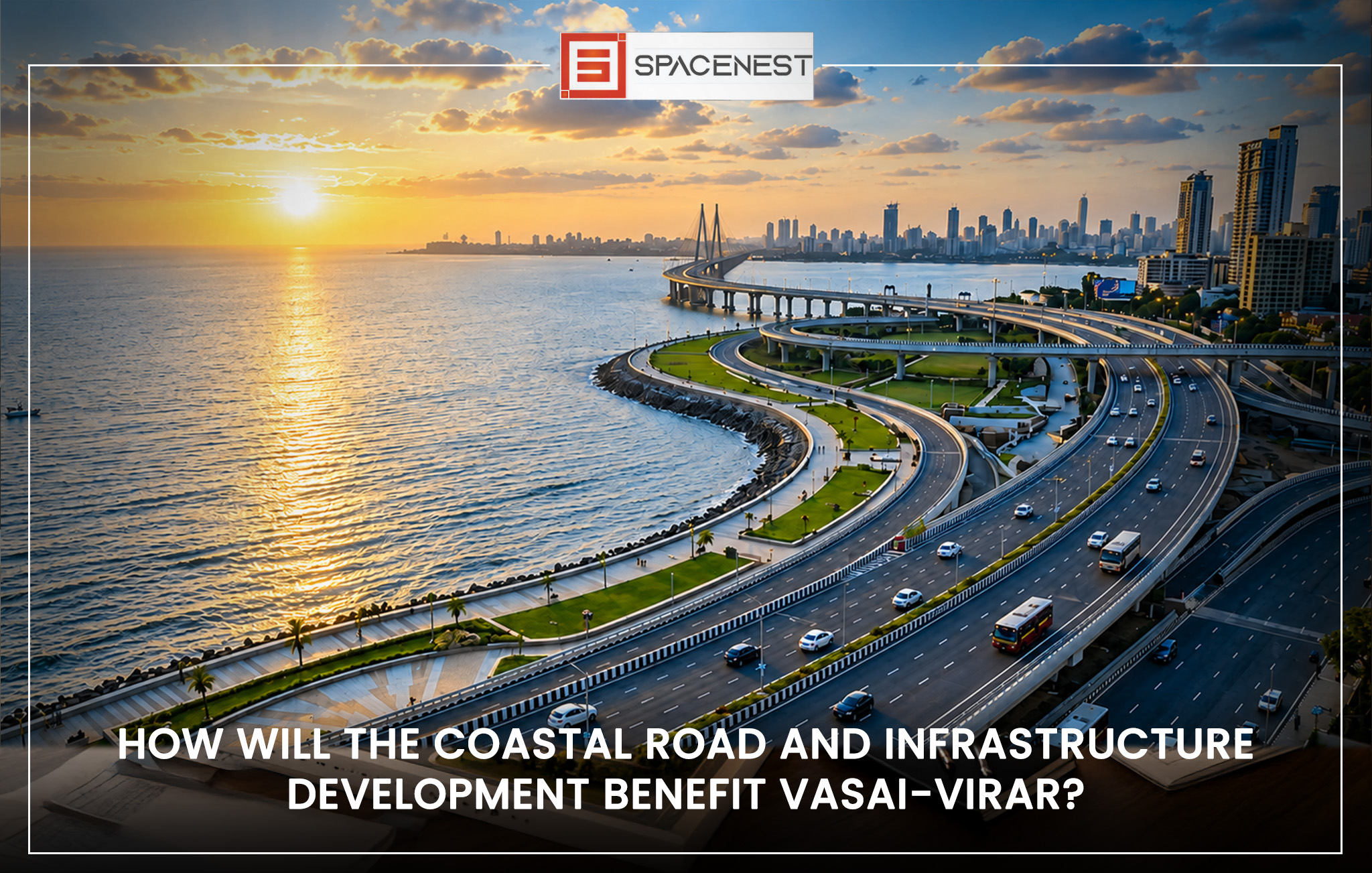
The Mumbai Coastal Road is primarily a Mumbai-city infrastructure project, so it is important not to describe it as a road running directly through Vasai-Virar. Its potential relevance to the wider Vasai-Virar market comes from its place within Mumbai’s broader transportation network and its connections with other major road corridors. At the same time, Vasai-Virar’s own infrastructure development, including highway improvements, rail connectivity, urban roads, and planned transport projects, can have a more direct effect on local mobility.
This distinction matters for homebuyers. Infrastructure does not increase property value simply because a project has been announced. The actual impact depends on whether a project is completed, where it connects, how much travel time it saves, and whether supporting infrastructure develops alongside it.
How Can the Coastal Road Benefit Vasai-Virar?
The Mumbai Coastal Road can potentially benefit residents of the wider Mumbai Metropolitan Region by improving movement along Mumbai’s western corridor and reducing pressure on some existing road routes. For Vasai-Virar residents, the benefit is therefore more indirect than it is for residents living immediately along the Coastal Road.
A better-connected western transport network can make it easier for people from areas north of Mumbai to access employment and commercial destinations farther south, particularly when connections between major highways and city roads work efficiently. The overall benefit will depend on how different road corridors connect with one another rather than on the Coastal Road in isolation.
For real estate, this creates an important principle: connectivity works as a network, not as a single road. When highways, arterial roads, bridges, railways, metro systems, and local roads complement each other, the accessibility of an area can improve significantly.
For Vasai-Virar, the long-term question is therefore not simply whether the Coastal Road exists. It is how the Coastal Road interacts with the region’s other infrastructure and whether those connections make commuting more predictable and convenient.
What Are the Biggest Infrastructure Benefits for Vasai-Virar?
Infrastructure development can influence Vasai-Virar in several ways, including transportation, employment accessibility, residential demand, commercial activity, and the development of surrounding neighborhoods. These effects usually happen gradually rather than immediately after a project is announced.
Better Road Connectivity
Road infrastructure is particularly important for a large urban region such as Vasai-Virar. The area has experienced substantial residential development, which makes efficient movement within the region and toward Mumbai increasingly important.
Improvements to major roads and connections with highways can help distribute traffic more effectively. For residents, better connectivity can mean more predictable journeys to workplaces, schools, healthcare facilities, shopping areas, and other daily destinations.
However, a new road does not automatically eliminate congestion. Traffic can shift to connecting roads, and rapidly growing populations can create additional demand. This is why buyers should examine the entire connectivity network rather than evaluating one infrastructure project on its own.
Can Better Infrastructure Increase Property Demand in Vasai-Virar?
Improved connectivity can contribute to residential demand when it makes an area more convenient for people to live in and commute from. If travelling between Vasai-Virar and major employment centres becomes easier, some households may consider the region more seriously when comparing housing options.
This is particularly relevant in markets where buyers balance property affordability and commute time. A home that offers more space or comparatively accessible pricing can become more attractive if transportation improves.
Still, infrastructure should be treated as one factor among many. Buyers should also consider the quality of construction, neighbourhood infrastructure, water supply, drainage, schools, healthcare, employment access, project approvals, and the developer’s track record.
From an investment perspective, infrastructure can influence demand, but future appreciation should never be treated as guaranteed. The actual market response depends on supply, demand, economic conditions, financing costs, and how successfully planned infrastructure is delivered.
How Will Improved Connectivity Help Daily Commuters?
For many Vasai-Virar residents, the most meaningful benefit of infrastructure development is not an abstract increase in property prices. It is the possibility of making everyday travel easier.
A commuter may use several forms of transport during one journey: a local road to reach a railway station, a train to travel toward Mumbai, and another road connection to reach the workplace. If even one major bottleneck improves, the overall journey can become more manageable.
This is why multimodal connectivity is important for Vasai-Virar. Roads and railways should complement one another rather than being considered separate systems.
Better transport infrastructure can also expand the practical area within which people can search for homes. A buyer may be willing to live farther from the workplace if the journey becomes sufficiently reliable and affordable.
What Role Will Rail and Other Transport Infrastructure Play?
Road development is only one part of Vasai-Virar’s connectivity story. The region’s railway network already plays a central role in connecting residents with Mumbai and other parts of the metropolitan region.
Future improvements to public transport and regional connectivity can potentially strengthen this role. When road and rail infrastructure develop together, residents have more options for travelling depending on destination, time of day, cost, and traffic conditions.
For real estate, this can influence which micro-markets become more attractive. A project located close to a reliable transport connection may offer a practical advantage over a similarly priced property with poor access.
However, buyers should distinguish between operational infrastructure and proposed infrastructure. A completed railway station or road should be evaluated differently from a project that is still awaiting approvals, funding, construction, or commissioning.
How Can Infrastructure Development Support Commercial Growth?
Improved connectivity can also support the growth of shops, offices, services, logistics activity, and other businesses. When an area becomes easier to reach, businesses may find it more practical to serve a larger customer base or workforce.
For Vasai-Virar, commercial development can create a reinforcing cycle. More businesses can generate employment and daily footfall, while a larger residential population creates demand for retail, healthcare, education, food services, and other facilities.
This does not mean every infrastructure project will automatically create a commercial hub. Successful commercial growth generally requires a combination of accessibility, population density, consumer demand, land availability, business investment, and supporting civic infrastructure.
For homebuyers, the practical takeaway is to examine whether the neighbourhood around a prospective property is developing a balanced ecosystem, rather than looking only at the nearest highway or proposed road.
What Should Homebuyers Check Before Buying Property in Vasai-Virar?
Infrastructure announcements can be useful indicators, but they should not be the only reason to purchase a property. A careful buyer should investigate the project’s current surroundings and distinguish completed infrastructure from proposed developments.
Important factors include:
- Current road and railway accessibility
- Actual travel time during peak hours
- Distance to schools and healthcare
- Availability of water, drainage, and other civic infrastructure
- Current and proposed transport projects
- Project approvals and applicable regulatory registrations
- Construction quality and amenities
- Developer track record
- Existing residential and commercial development
- Total purchase cost, including applicable charges
A simple test is useful: Would you still consider the property if the proposed infrastructure project were delayed? If the answer is no, the investment decision may be relying too heavily on an uncertain future benefit.
Why Could Vasai-Virar Become More Connected Over Time?
Vasai-Virar’s position within the wider Mumbai Metropolitan Region gives infrastructure planning particular importance. As housing demand expands beyond Mumbai’s traditional core, transport connectivity becomes increasingly important in determining how comfortably residents can access employment and services.
The region’s development should therefore be viewed over the long term. A combination of road improvements, railway connectivity, regional transport projects, and local civic infrastructure can gradually change how different parts of Vasai-Virar function.
The Coastal Road’s significance should be understood in this broader context. It is not accurate to suggest that the Coastal Road alone will transform Vasai-Virar. Instead, its potential contribution is part of a larger western-region connectivity network.
For buyers researching the area, this broader approach is more useful than focusing on a single headline infrastructure project.
What Does Infrastructure Development Mean for Vasai-Virar Real Estate?
The relationship between infrastructure and real estate is straightforward at a broad level: better accessibility can make locations more practical, and practical locations can attract residential and commercial demand.
But the timing and scale of that effect vary. A completed transport project serving a densely populated neighbourhood can have a different impact from a proposed project that may take years to materialise.
This is particularly important in Vasai-Virar, where different micro-markets can have very different connectivity profiles. Two properties within the same broad region may offer very different commuting experiences depending on their proximity to railway stations, major roads, employment corridors, and local amenities.
Therefore, prospective buyers should evaluate infrastructure at the micro-market level rather than treating all of Vasai-Virar as one uniform property market.
Conclusion
The potential benefits of infrastructure development in Vasai-Virar extend beyond shorter journeys. Better road, rail, and regional connectivity can improve access to employment, support commercial activity, strengthen neighbourhood development, and make the region more practical for households seeking housing within the wider Mumbai Metropolitan Region.
The Mumbai Coastal Road can contribute to the broader western Mumbai transportation network, but its impact on Vasai-Virar should be understood as an indirect network effect rather than a direct local road benefit. The region’s own road, rail, and civic infrastructure will remain equally important in determining how connectivity evolves.
For homebuyers, infrastructure is best viewed as one part of a larger property decision. Instead of buying solely on the promise of future development, examine what connectivity exists today, what projects are actually under construction, and whether the surrounding neighbourhood has the infrastructure needed for comfortable long-term living.
FAQs
1. Will the Mumbai Coastal Road directly connect Vasai-Virar?
No. The Mumbai Coastal Road is a Mumbai-city road project and should not be described as a direct road through Vasai-Virar. Its relevance to Vasai-Virar is primarily through the wider western Mumbai transportation network and connections with other major corridors.
2. How can infrastructure development benefit Vasai-Virar real estate?
Better connectivity can improve accessibility to employment centres and essential services, potentially supporting residential and commercial demand. However, infrastructure does not guarantee property appreciation, and buyers should evaluate each location individually.
3. Is Vasai-Virar a well-connected residential region?
Vasai-Virar has established rail and road connectivity with Mumbai and surrounding areas, while ongoing and planned infrastructure can further influence accessibility. Actual convenience varies considerably between different neighbourhoods and properties.
4. Should I buy property in Vasai-Virar because of upcoming infrastructure?
Infrastructure should be one factor in a property decision rather than the sole reason to buy. Check the project’s current connectivity, approvals, construction status, neighbourhood infrastructure, total cost, and realistic commuting requirements before making a decision.
5. Can better connectivity increase demand for homes in Vasai-Virar?
Improved connectivity can make a location more accessible and potentially increase its attractiveness to homebuyers and businesses. The actual effect depends on factors such as project completion, affordability, housing supply, employment growth, and the quality of local infrastructure.